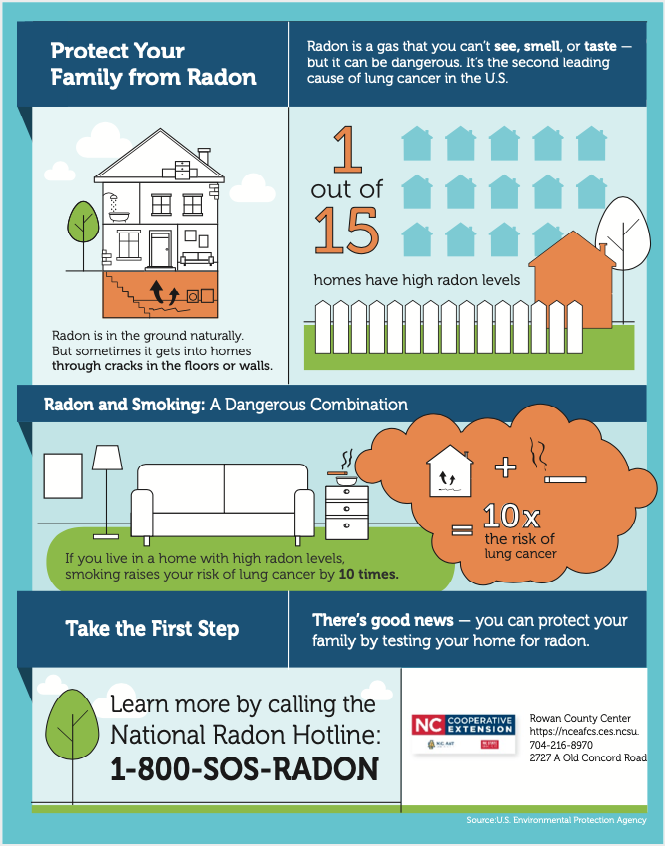
National Radon Action Month is a time to increase awareness of radon and to spur advocacy on behalf of those suffering from the emotional, financial and physical burden of radon exposure. Radon is a naturally occurring radioactive gas that you cannot see, smell, or taste so it could be present at dangerous levels in your home without you knowing it.
Radon is the second leading cause of lung cancer deaths in the United States and the number one leading cause among non-smokers, claiming more than 20,000 lives every year. Exposure to radon is a preventable health risk, and testing radon levels in your home can help prevent unnecessary exposure. If a high radon level is detected in your home, it can be fixed through mitigation, radon reduction techniques, and reduction systems.
This year, the North Carolina Radon Program is giving 3,000 radon test kits free of charge. These are short-term kits but can be very helpful in determining if there is a presence of radon in your home. They will provide one test kit per household.
To get your radon kit, go to the North Carolina Radon Program site.
Also, here are a few additional sites that you can visit for more information:
NC State Extension Healthy Homes – Radon
Environmental Protection Agency – Radon
Toi N. Degree, Associate Family & Consumer Education Agent with North Carolina Cooperative Extension. Toi may be reached by phone at 704-216-8970 or by email at toi_degree@ncsu.edu.